

We know that many Las Vegas Athletic Club members are parents. While our focus is on physical health and fitness, we recognize that the health of the mind is just as important — especially for growing children in our local Las Vegas community. Supporting the whole family means paying attention not only to physical wellness, but to the developmental milestones that shape a child’s future, starting well before elementary school.
Pre-k is often perceived as a simple stepping stone before elementary school begins. In reality, these early years of structured learning represent one of the most formative periods in a child’s development — and their benefits extend well beyond the classroom, offering meaningful support for parents as well. Understanding what happens during Pre-K, and why it matters, can help families make informed decisions about early education.
Early Brain Development: A Critical Window
Between the ages of three and five, children experience one of the most rapid periods of brain development in their lives. Millions of neural connections form during this stage, laying the groundwork for future learning. Quality Pre-K programs are designed to take advantage of this window, introducing early literacy, numeracy, and problem-solving skills through age-appropriate, engaging methods.
Developing Social and Emotional Skills
Academic readiness is only part of the picture. Pre-K also provides children with essential opportunities to develop social and emotional competencies. Sharing, taking turns, resolving conflicts, and navigating group dynamics are skills best learned through direct experience — not instruction alone.
Through daily interactions with peers, children build empathy, cooperation, and self-regulation. These early experiences with group settings and structured social environments form a foundation for healthy relationships throughout childhood and into adulthood, including future academic collaboration and workplace interaction.
Structure and Routine: Teaching Independence Early
The predictable rhythms of a Pre-K classroom — circle time, transitions, cleanup, and scheduled activities; teach children valuable lessons in time management, patience, and personal responsibility. Learning to follow a routine and manage small tasks independently helps ease the transition into the more structured demands of elementary school.
Learning Through Play
Effective Pre-K programs prioritize play-based learning over rote memorization. Activities such as imaginative play, puzzles, and outdoor exploration support cognitive development, language acquisition, and motor skills simultaneously. Research consistently shows that hands-on, playful learning experiences lead to stronger retention and cultivate a genuine enthusiasm for learning — an outcome that benefits children far beyond their Pre-K years.
The Benefits for Parents
The advantages of Pre-K aren’t limited to children — parents and caregivers benefit significantly as well.
Peace of mind and reliable support. Enrolling a child in a licensed, quality Pre-K program provides parents with confidence that their child is in a safe, nurturing, and educationally enriching environment during the workday.
A window into development. Regular communication with Pre-K educators gives parents valuable insight into their child’s academic and social progress, often surfacing early observations about learning styles, strengths, or areas that may benefit from additional support.
A collaborative approach to early education. Many programs actively involve parents through take-home activities, conferences, and shared learning goals, creating a partnership between home and classroom that reinforces consistency for the child.
Time and flexibility. Pre-K provides working parents with structured, dependable child care that supports professional obligations while ensuring their child’s day is purposeful and enriching rather than simply supervised.
Reduced transition stress. Parents often find that children who have attended Pre-K adapt more smoothly to kindergarten, having already developed the independence and social skills needed for a larger classroom setting. This can ease the anxiety many parents feel about their child’s readiness for formal schooling.
The Long-Term Impact
Longitudinal research consistently demonstrates that children who attend quality Pre-K programs tend to achieve stronger academic outcomes in reading and math, exhibit better social skills, and show higher rates of high school graduation. These early investments in structured learning and social development create a compounding effect, supporting success well beyond the early childhood years.
Every Child in Las Vegas Deserves a Strong Start
Kindergarten readiness starts long before the first day of school. If you’re comparing pre-K options for your child, here’s one worth checking first.
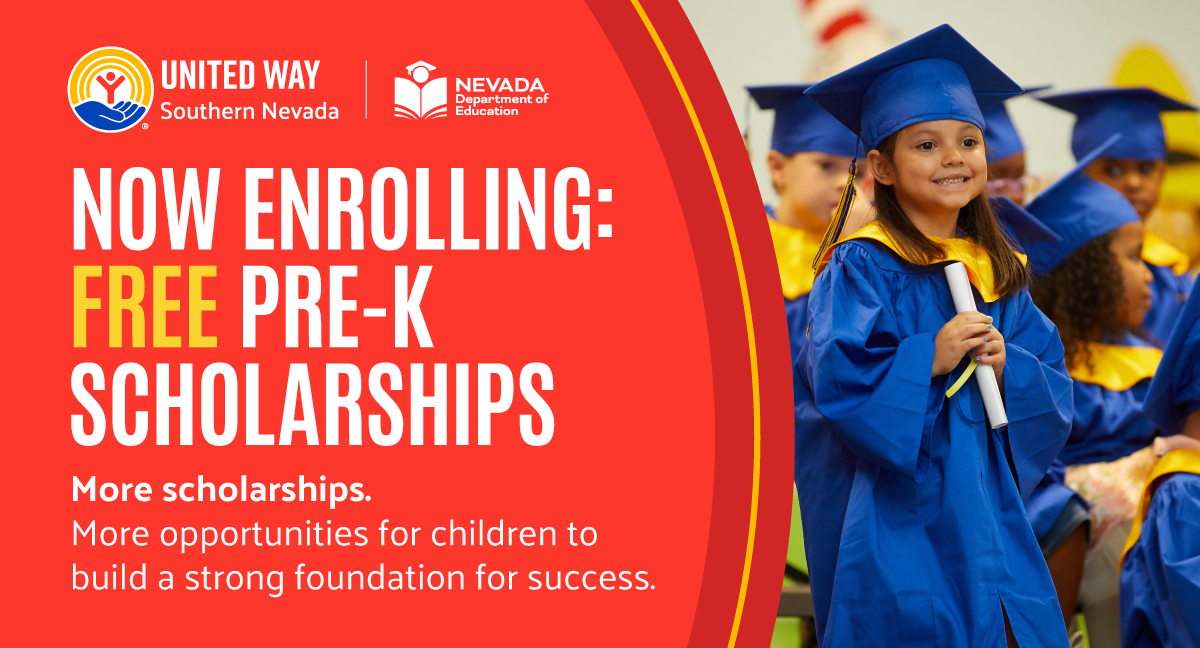
The Nevada Ready! State Pre-K program, offered through a partnership with United Way of Southern Nevada (UWSN) and the Nevada Department of Education, helps qualifying families access early education scholarships and prepare children for kindergarten without a hefty price tag.
What the program includes:
- Full pre-K tuition covered for qualifying families
- Classrooms staffed by teachers who receive ongoing training in current, research-backed early education techniques
- Support for building the literacy, social, and problem-solving skills kids need for kindergarten and beyond
Does your child qualify?
Visit the First 5 Nevada website to complete the free eligibility check: first5nevada.org/check-eligibility/
It takes just a few minutes and absolutely no obligation to enroll if you decide it’s not the right fit. If your family qualifies, you’ll have access to a program that’s already helped thousands of Southern Nevada kids start kindergarten ready and confident.
United Way of Southern Nevada believes access to early education shouldn’t depend on a family’s zip code or income. Want to learn more about UWSN’s work in early education? Visit our website for more information: https://uwsn.org/early-education/